Made in America. Sold worldwide.





Celazole® PBI can act as an excellent thermal resistant coating and can be film cast, sprayed, dipped or spin-coated onto metal, glass and other substrates
Polybenzimidazole can also be used as a thermal resistant coating. By dissolving the PBI polymer into highly polar aprotic solvents like n,n-dimethylacetamide (DMAc), dimethylsulfoxide (DMSO), or n-methylpyrrolidone (NMP), PBI can be cast, sprayed, dipped or spin-coated onto metal, glass and other substrates – then cured to yield thermally resistant coatings. Such coatings can serve to protect substrates from corrosion, function as a dielectric layer, serve as a thermal insulator or as a high temperature adhesive.
40%
In a scratch resistance study, the scratch depth of PBI was shown to be 39% shallower than PEEK, 43% shallower than polyimide with 2% graphite, and PBI had the highest penetration recovery.
HIGH PERFORMANCE
Coatings of Celazole® PBI are highly resistant to heat and chemical attack, and will also provide electrical insulation and wear resistance.
FLEXIBILITY
In some situations, old PBI coatings can be stripped and renewed with a new PBI coating.
APPLICATIONS
Tie layer
Used in conjunction with PEEK or PAI, Celazole PBI coating makes a great tie layer to bridge CLTE mismatch. CLTE of 23 µm/mC matches that of aluminum.
Fan blades
PBI coatings provide an anti-fouling and low friction surface for fans in high temperature gas streams.
Valve bodies
Used on the interior of a valve body, PBI coatings provide corrosion resistance with 9000 psi adhesive strength.
Oven parts
Coating the interior of oven parts reduces corrosion caused by off-gases.
Semiconductor
Shielding of metal end-effectors and chamber parts for reducing metal exposure or imparting anti-stat property.
Base layer
Used with PEEK or PPS, Celazole PBI forms a tight bond to metal substrates and helps alleviate cracks due to shrinkage of crystalline top layers.
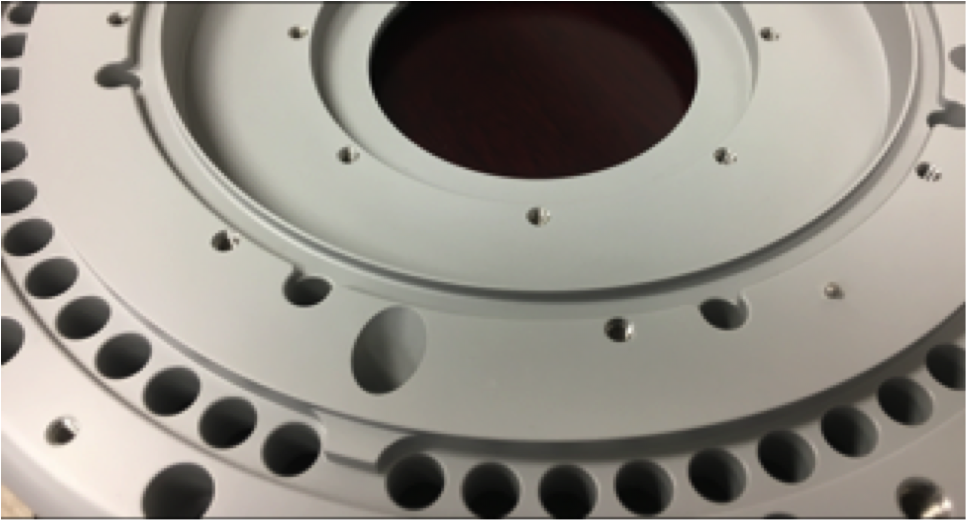
Semi-crystalline polymers, such as PPS, PEEK and C-PEKK can be difficult if not impossible to apply as coatings to certain geometric surfaces. The high melt temperatures of these polymers create stresses during processing due to a mismatch in the coefficient of thermal expansion (CLTE) between the polymer and metal. The high shrinkage caused by crystallization coupled with low elongation causes cracking, pin holing, poor adhesion and delamination.
A solution to these problems has been discovered by Southwest Impreglon, Inc. (SWI) of Houston, Texas, a custom coatings applicator of high performance polymer coatings such as PAI, PEEK, PEKK, PTFE, PFEA, ECTFE, PVDF, and most recently Celazole® PBI brand Polybenzimidazole. They’ve discovered that in using PBI as a tie layer, they’ve solved CLTE mismatches between metal substrates and semi-crystalline polymers. The coating is improved in all geometries; resisting cracking due to bending coated metal structures compared to monolayer-coated parts.
Part geometries once thought as being impossible to coat can now be coated. From fan blades to valve body interiors, many geometries can work.